
Dr Singh briefed Obama about the peace initiatives with Pakistan, but made it clear that Islamabad should abide by its commitment of not to allow terrorism emanating from its soil directed against India.

"You have caught the imagination of millions across the world, including the people of India who are anxiously waiting for your visit."
India made plain its opposition to China on issuance of stapled visas to Kashmiris and developmental work in Pakistan-occupied Kashmir on Wednesday, even as the two sides inked an agreement to set up a hotline between their prime ministers.

New Delhi identified the specific barriers which it said were coming in the way of high-technology trade at the day-long seventh meeting of the US-India high-technology cooperation group in Washington.

India demanded the handover of retired Army Major Iqbal besides Hafiz Saeed and some Lashkar operatives like Muzzamil, Abu Hamza, Abu Kahfa, Usman and Sajjid Mir in connection with the Mumbai terror attacks. The other fugitives demanded by India were Indian Mujahideen chief Asif Raza Khan and its senior member Riaz Bhatkal
Foreign Secretary Nirupama Rao and her Pakistani counterpart Salman Bashir will be meeting at New Delhi on February 25,2010, under a face-saving formula which would enable both the governments to claim that the respective stand taken by them after the 26/11 terrorist strike in Mumbai stands vindicated by this meeting.
United States President Barack Obama's Special Envoy for Pakistan and Afghanistan, Richard Holbrooke, who is currently on a three-day visit to Pakistan, is expected to make a short visit to New Delhi on Friday.
The Indian Embassy in Beijing immediately took up the matter with the Chinese government and sought Consular access to them, they said. The Consular access has been granted for Wednesday.
Bangladesh Prime Minister Sheikh Hasina arrived in New Delhi on Sunday night on her maiden visit, which India sees as "a path-breaking and historic opportunity" to forge a "new and forward-looking" relationship amid hopes that its security concerns would be addressed.

"As far as arrangements for reprocessing talks are concerned these are ongoing. We are not looking at finalising them on Wednesday in any case," Foreign Secretary Nirupama Rao told media-persons, hours ahead of Singh-Obama talks at the White House.

Hinting at Pakistani link to the Kabul embassy attack, India on Saturday said Afghanistan faces threat from terrorists and their "patrons residing across the border" and that the blast was handiwork of those who want to undermine Indo-Afghan friendship.
For the last eight years, since the Taliban fled from Kabul in November 2001, India has staunchly opposed a dialogue with any section of it. India's position has remained: there is no purpose in talking to the Taliban; there is no such thing as a moderate Taliban.
So, what is in a menu, you might ask. Oh, a world and more. Especially, if it is to do with a high-profile lunch hosted by the Indian foreign office for a Pakistani delegation.The lunch hosted on Thursday at Hyderabad House in central Delhi by Foreign Secretary Nirupama Rao is as elaborate as the menu is carefully chosen. There is Gosht curry (lamb preparation). That itself is significant.
Foreign Secretary Nirupama Rao will arrive in Islamabad at 10 am on Thursday and she will have her first meeting with her Pakistan counterpart Salman Bashir later that evening. The two full delegations will then have two sessions on Friday.
With the situation in Libya remaining volatile, government on Tuesday said it was putting in place plans for possible evacuation of Indians whose number is around 18,000.
Libyan Ambassador to India Ali al-Essawi has reportedly resigned in protest against his government's violent crackdown on demonstrators.
The External Affairs ministry was at odds with the Jammu and Kashmir government over reports on Chinese intrusion in Ladakh, saying no such incident had taken place and the media reports carrying the same were "baseless".
Ahead of a series of bilateral meetings, India demanded "credible" action by Pakistan in the 26/11 terror attack case on Tuesday, saying the core issue of addressing the country's concerns on the issue will be part of these parleys.
Addressing the SAARC Standing Committee meeting in Thimphu, Foreign Secretary Nirupama Rao said that SAARC has evolved into a service provider for the economic and development needs of the people of the region.
'The Washington summit is as much about nonproliferation and arms control as about nuclear security,' says T P Sreenivasan.
Separately, Foreign Minister Shah Mahmood Qureshi said during a meeting with his Norwegian counterpart Jonas Gahr Store in Islamabad that Pakistan wanted its ties with India to normalise "by resolving bilateral disputes through a sustained and meaningful dialogue process."However, "engaging in talks for the sake of talks would serve no purpose," he was quoted as saying in a statement issued by the Foreign Office.
Indian Consul General in Chicago Ashok Atri, embroiled in a controversy over visa issued to Lashkar-e-Tayiba operative Tahawwur Hussain Rana, has met Union External Affairs Minister S M Krishna and said that no rules had been violated in giving him the travel document, as he had submitted all proper papers for the same.
Afghanistan President Hamid Karzai on Friday assured India that a thorough investigation would be conducted into the suicide bomb attack near the Indian embassy in Kabul to ascertain who was behind it.
External affairs Minister SM Krishna has taken on Lashkar-e-Tayiba founder and Jama'at-Ud-Dawa chief Hafiz Saeed saying India believes Saeed is the "brain" behind the Mumbai attacks of November 2008, telling Pakistan's government that if it wants to prove its seriousness on tackling terror, it must tackle Saeed.
Taking a serious note of the killing of two Indian fishermen allegedly by the Sri Lankan Navy, India on Tuesday told Colombo that the use of force against them should not be repeated and asked it to take a decision that will not upset bilateral ties. External Affairs Minister S M Krishna also directed Foreign Secretary Nirupama Rao to convene a meeting of the Indo-Sri Lanka Joint Working Group on the issue around February 15 to discuss the issue.
India said on Sunday that it is yet to get access to Lashkar-e Taiba operative David Headley but negotiations are underway on this issue and it is "satisfied" with the progress of discussions.
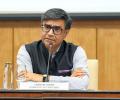
Foreign Secretary Vikram Misri, who faced trolling on social media in the wake of India and Pakistan reaching an understanding on May 10 to halt all military actions, has received support from veteran diplomat Nirupama Menon Rao, a body of Indian diplomats and a host of politicians from several parties.
When Nirupama Rao became India's foreign secretary in August, only the second woman to get the top job, the grapevine around the Ministry of External Affairs had it that she would struggle to put her stamp on South Block, writes Jyoti Malhotra.

'India is at a critical juncture in this century. I want to be a part of the diplomatic team that works to make India great.'

Iran is fighting a different war: Older, slower, and in some ways more dangerous. Iran doesn't need to shoot down an F/A-18. It only needs to make the Strait of Hormuz feel dangerous long enough for insurance markets, shipping companies, and oil futures traders to do the rest. Prem Panicker continues his must-read daily blog on the war in the Middle East.
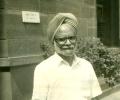
Dr Manmohan Singh first embossed himself on the national consciousness when as India's finance minister he flagged off economic reforms which changed this nation forever.

What we are watching is something different: A fog manufactured and maintained by the people who started the war, so that the question of why it was started never has to be answered, observes Prem Panicker in his must read blog on the war in the Middle East.

Prime Minister Manmohan Singh on Friday held talks with US President Barack Obama, the first bilateral summit meeting after nearly three years.
After the ice-breaking foreign secretary-level talks on February 25, India has conveyed to Pakistan its willingness to hold the second round of parleys, but is yet to get any response from its neighbour. India also has not heard anything from Pakistan on the three dossiers given to Foreign Secretary Salman Bashir by her Indian counterpart Nirupama Rao during the FS-level talks. The dossiers contained the names of the 34 Pakistani terrorists wanted in India.

Strategic affairs experts express concern over US President Donald Trump's tariffs on India, his 'bullying tactics,' and increasing attempts to hyphenate New Delhi with Islamabad, signaling a potential shift in the bilateral relationship.
A host of issues like the civil nuclear cooperation, Iran and Afghanistan figured in talks between Secretary of State Hillary Clinton and Indian envoy Nirupama Rao, with both agreeing to work for consolidating the "tremendous progress" made in boosting Indo-US strategic ties.
Nirupama Rao, who took over as the foreign secretary on August 1, has had a variety of issues on her platter -- the reported incursions by China along the border, the attack near the Indian embassy in Kabul, Pakistan dilly-dallying on prosecuting Mumbai terror attack mastermind Hafiz Saeed and the mounting political pressure over the rehabilitation of displaced Tamils in Sri Lanka.
Foreign secretaries of India and Pakistan -- Nirupama Rao and Salman Bashir -- have begun their much-anticipated meeting in Islamabad on Thursday, even as Indian officials have said that New Delhi is "looking at these talks in a positive and constructive manner".
At the end of the talks with Salman Bashir, Pakistani Foreign Secretary in New Delhi on Thursday, Nirupama Rao, the Indian counterpart, projected the initiative taken by India in proposing the meeting between the two countries as a prelude to a wider dialogue at different levels on various contentious issues -- though not necessarily in the form of a reversion to the composite dialogue process to which Pakistan continues to be attached.
